The Barri Gòtic grew up inside the Roman and medieval walls, and fragments of them still surface near the cathedral and along Via Laietana. Some streets are narrow enough to touch both sides, then suddenly open onto squares such as Plaça del Pi, Plaça de Sant Felip Neri and the arcaded Plaça Reial. Living here puts the Rambla, the Liceu opera house and the waterfront at Port Vell a few minutes away on foot, and you rarely need public transport to reach anything central. On Sunday mornings neighbours dance the sardana, the Catalan circle dance, in front of the cathedral, and every December the Santa Llúcia Christmas fair fills the same square.
Getting around Metro L3 at Liceu and Drassanes, L4 at Jaume I, and L1/L3 at Catalunya on the edge, where FGC and Rodalies trains also stop.
Living in Gothic Quarter · 187 furnished homes
El Raval runs from the Rambla west to the Ronda de Sant Antoni and Avinguda del Paral·lel, and it has changed more over recent decades than anywhere else in Ciutat Vella. The white MACBA building and the CCCB anchor a cluster of galleries, bookshops and record stores around Plaça dels Àngels, while the Rambla del Raval, home to Botero's oversized cat, gives the southern half a wide promenade for terraces. The Boqueria market sits right on its eastern edge. At weekends skateboarders take over the plaza in front of MACBA, a spot known to skaters worldwide.
Getting around Metro L3 at Liceu and Drassanes, L2/L3 at Paral·lel, and L1/L2 at Universitat plus L2 at Sant Antoni along the northern edge.
Living in El Raval · 167 furnished homes
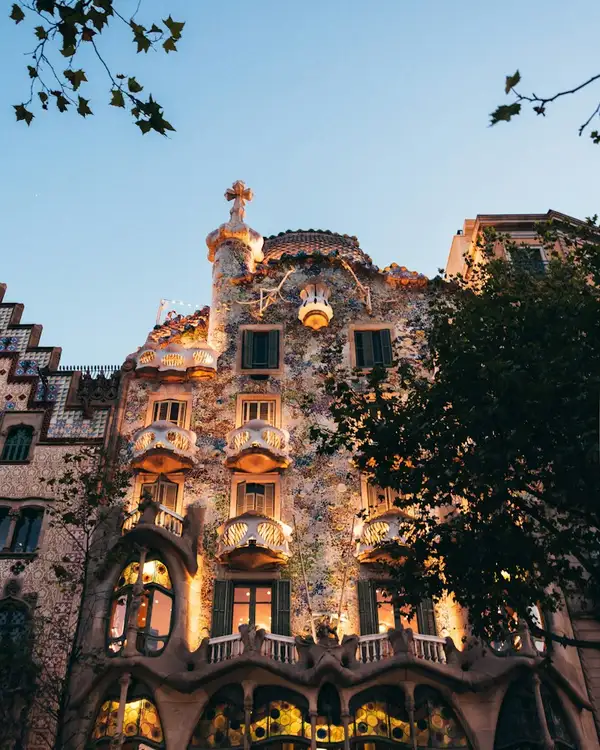
When Ildefons Cerdà's Eixample grid was built in the nineteenth century, the right-hand side filled first with the new bourgeoisie, and it shows. Passeig de Gràcia carries Casa Batlló and Gaudí's La Pedrera, while side streets such as Consell de Cent, Aragó, Mallorca and Girona are lined with stone facades, carved doorways and wrought-iron balconies. The chamfered corners at every junction, the xamfrans, give the area its airy, open feel. Towards Passeig de Sant Joan and the Arc de Triomf the blocks turn more residential, with neighbourhood bakeries, schools and the shaded central walkway of the passeig itself.
Getting around Metro L2, L3 and L4 at Passeig de Gràcia, L4 at Girona, L3/L5 at Diagonal and L4/L5 at Verdaguer, plus Rodalies trains at Passeig de Gràcia.
Living in Dreta de l'Eixample · 152 furnished homes
This is the half of Ciutat Vella on the far side of Via Laietana, and locals usually just call its southern part El Born. The basilica of Santa Maria del Mar closes off Carrer de Montcada, home to the Picasso Museum, and the old Born market hall now shelters a cultural centre built over excavated streets from the early eighteenth century. Further north, Santa Caterina market with its wavy, multicoloured roof and the Palau de la Música Catalana mark the more residential Sant Pere side. The lanes in between are some of the most photogenic in the city.
Getting around Metro L4 at Jaume I and Barceloneta, L1 at Arc de Triomf and L1/L4 at Urquinaona, with Rodalies trains at Arc de Triomf and Estació de França close by.
Living in El Born & Sant Pere · 86 furnished homes
West of Carrer de Balmes the Eixample grid carries on, but the mood shifts. The Antiga Esquerra, the older part of the left side, is where the historic Universitat de Barcelona building faces Plaça Universitat, where Hospital Clínic fills an entire block and where the Mercat del Ninot feeds the streets around it. The modernista showpieces are fewer than on the right side, yet the facades are still handsome and the scale is a little more human. The UB building's cloisters and gardens make a calm spot to read between classes.
Getting around Metro L5 at Hospital Clínic, L1 at Urgell and L1/L2 at Universitat, plus FGC trains at Provença for Sant Cugat and the UAB.
Living in Antiga Esquerra de l'Eixample
Gràcia was an independent town until the end of the nineteenth century, and walking up from Diagonal you can feel the change: the grid breaks into crooked streets, buildings drop to three or four floors, and life revolves around squares. Plaça del Sol fills with students on summer nights, Plaça de la Virreina is gentler with its church and terraces, and Plaça de la Vila keeps the clock tower that became the neighbourhood's emblem. Carrer Gran de Gràcia, the main shopping street, runs down the western side towards Passeig de Gràcia, while Travessera de Gràcia crosses the neighbourhood from east to west.
Getting around Metro L3 at Fontana and Lesseps, L4 at Joanic and L3/L5 at Diagonal, plus FGC trains at Gràcia station on the western side.
Living in Gràcia · 102 furnished homes
Uphill from Diagonal and west of Via Augusta, Sant Gervasi–Galvany is where Barcelona goes when it wants peace and a concierge. Streets are wider and greener than in the old town, many buildings date from the mid-twentieth century with terraces and garages, and Turó Park offers a manicured patch of shade for reading or a run. The Mercat de Galvany, a handsome early twentieth-century market hall, is where the neighbourhood does its daily shopping. Uphill, the streets climb towards El Putxet and La Bonanova, with more gardens and villas, and the trails of Collserola are within reach for weekend hikes.
Getting around FGC trains at Muntaner, Sant Gervasi and Plaça Molina, metro L3/L5 at Diagonal, and the Trambaix from Francesc Macià on the lower edge.
Living in Sant Gervasi–Galvany
Sant Antoni takes its name and its heart from the Mercat de Sant Antoni, a cross-shaped iron market hall that reopened after a long restoration. On Sunday mornings the ring around it hosts a second-hand book, comic and coin market that has run for generations. In between, the streets around Carrer del Parlament and Comte Borrell are packed with cafés, brunch spots and vermouth bars, and a superblock scheme has turned several junctions into car-light squares with benches and planters. The restoration also uncovered remains of the old city fortifications, now visible beneath the market.
Getting around Metro L2 at Sant Antoni, L1 at Urgell and Rocafort, and L2/L3 at Paral·lel, where the funicular climbs to Montjuïc.
Living in Sant Antoni
The crowds at Plaça de Gaudí and Plaça de la Sagrada Família rarely wander more than a block or two, which leaves the rest of the district to the people who live here. It is a straightforward stretch of the eastern Eixample: grid streets, ordinary shops, schools and the Mercat de la Sagrada Família. Avinguda de Gaudí, a diagonal promenade lined with terraces, links the basilica to the modernista Sant Pau hospital complex. Two small squares flank the basilica, with ponds and benches that belong to visitors by day and to neighbours on summer evenings.
Getting around Metro L2/L5 at Sagrada Família, L5 at Sant Pau | Dos de Maig and L2 at Monumental and Encants, with trams at Glòries.
Living in La Sagrada Família