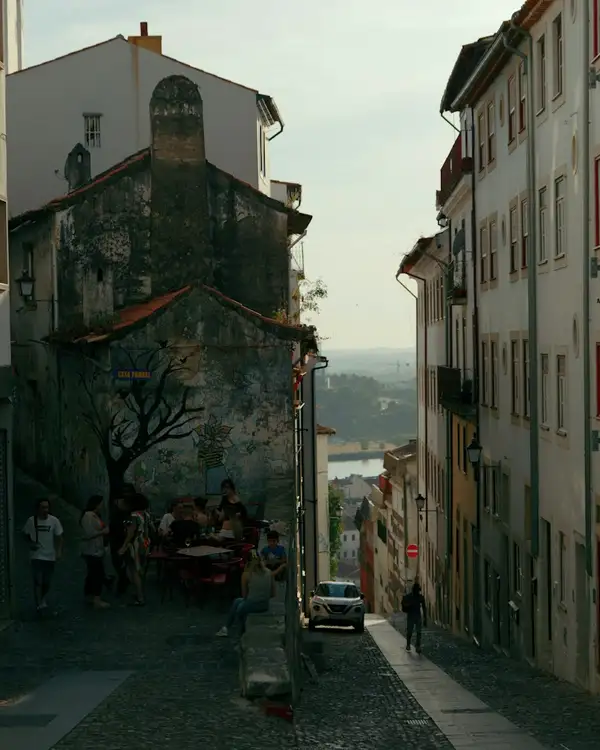
The Baixa is the flat, busy part of old Coimbra, spread between the Mondego and the foot of the university hill. Rua Ferreira Borges and Rua Visconde da Luz carry shoppers from Largo da Portagem up to Praça 8 de Maio, where the Monastery of Santa Cruz holds the tombs of Portugal's first two kings and Café Santa Cruz serves coffee beneath Gothic vaults in a former church. Rua da Sofia, laid out in the sixteenth century for the university's colleges, is part of the UNESCO World Heritage site together with the Alta.
Getting around Many SMTUC bus routes pass Largo da Portagem and Avenida Fernão de Magalhães, and the Elevador do Mercado links the Baixa with the Alta.
Living in Baixa · 97 furnished homes
The Alta is the Coimbra of postcards and student songs. At its summit stand the Paço das Escolas, the former royal palace that became the university's home, the gilded baroque Joanina Library and the clock tower that students nickname 'a cabra', the goat. Below them, lanes such as Rua do Quebra-Costas, whose name roughly means 'back-breaker', wind down past the Romanesque Sé Velha, on whose steps graduates sing Coimbra fado during the Queima das Fitas serenade. Visitors queue for the library by day, but by evening the lanes belong to students again.
Getting around SMTUC buses reach the university area, and the Elevador do Mercado connects the hilltop with the Baixa and the municipal market.
Living in Alta Universitária · 50 furnished homes
Montes Claros climbs the slope east of Praça da República, the square where Coimbra's students gather for coffee in the afternoon and beer late into the night. Its streets, among them Rua Lourenço de Almeida Azevedo, Rua Guerra Junqueiro and Rua Diogo de Castilho, are lined with older family houses, small apartment buildings and gardens hidden behind stone walls. At the bottom lies Santa Cruz Park, known to everyone as the Jardim da Sereia, with its fountains, tiled benches and shaded paths that make a calm place to read between classes.
Getting around SMTUC buses along Avenida Sá da Bandeira and around Praça da República, with Pólo I and Celas within walking distance.
Living in Montes Claros · 66 furnished homes
The Penedo da Saudade is a hilltop garden with long views over the eastern side of the city, and for generations graduating classes have left verses and farewells on stone plaques among its trees. Its name evokes saudade, the untranslatable Portuguese word for longing, and the place has inspired poets since the nineteenth century. The residential streets around it, including the long Rua dos Combatentes da Grande Guerra, run downhill towards Calhabé and the city stadium. It is one of the few places in Coimbra where you can feel close to the centre and still hear birds rather than traffic.
Getting around SMTUC buses along Rua dos Combatentes da Grande Guerra link the area with Praça da República, Solum and the Baixa.
Living in Penedo da Saudade · 32 furnished homes
Solum is Coimbra's modern face. Built as a planned residential district on the eastern side of the city, it is a neighbourhood of apartment blocks with lifts, wide pavements, ground-floor shops and cafés, laid out around the Estádio Cidade de Coimbra, home ground of the historic Académica football club. Streets such as Rua Carolina Michaëlis and Rua General Humberto Delgado are lined with buildings that offer what the historic centre often lacks: natural light, parking and better insulation.
Getting around Frequent SMTUC buses connect Solum with Praça da República, the Baixa and the university's Pólo II campus.
Living in Solum · 27 furnished homes
Cross the Santa Clara bridge from Largo da Portagem and you reach the south bank, where the whole of old Coimbra suddenly lines up in front of you: the river, the Baixa and the university tower on its hill. The low-lying area by the water holds the Gothic monastery of Santa Clara-a-Velha, half-buried by Mondego floods for centuries and now restored, and Portugal dos Pequenitos, a park of miniature Portuguese buildings loved by children. Uphill stands Santa Clara-a-Nova, where the city's patron saint, Queen Isabel, is buried.
Getting around SMTUC buses cross the Santa Clara bridge to the Baixa, and the Pedro e Inês footbridge links the riverside parks on both banks.
Living in Santa Clara · 28 furnished homes
Celas takes its name from the old Cistercian convent whose medieval cloister, with its carved capitals, still stands among the apartment buildings. Over the twentieth century the area grew into a dense residential neighbourhood, and the arrival of the university hospital and the Pólo III health sciences campus turned it into one of the most student-heavy parts of Coimbra outside the Alta. Today it feels lived-in and practical rather than picturesque, with a steady flow of students, doctors and patients through its streets. Mosteiro de Celas, as the convent is known locally, is still worth a visit for its quiet cloister.
Getting around SMTUC buses link Celas with the hospital, Praça da República and the Baixa, and Pólo I is reachable on foot.
Living in Celas
Montarroio occupies the hillside rising behind Rua da Sofia towards Praça da República and the Alta, a short but steep climb on foot. Its narrow streets, Rua de Montarroio among them, are stitched together by stairways and passages, with small old houses, tiled façades and the occasional garden glimpsed over a wall. Little here was formally planned, and that is part of its charm: turn a corner and you may find a tiny square, a neighbour's washing line or a sudden view over the rooftops of the Baixa.
Getting around Mostly walkable; SMTUC buses run along Avenida Sá da Bandeira and Rua da Sofia at the edges of the quarter.
Living in Montarroio