
Centre-ville
Ducal palace, half-timbered streets and Les Halles
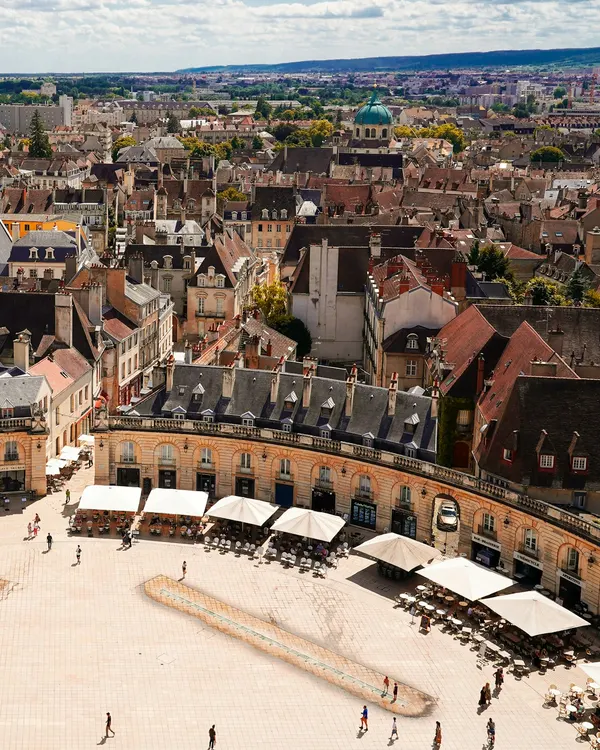
Dijon's centre is one of the best-preserved historic centres in France. The Palace of the Dukes and States of Burgundy, now the town hall and the Musée des Beaux-Arts, faces the semicircular Place de la Libération, and rue de la Liberté, the main shopping street, runs from there to Place Darcy. Around them, narrow streets of half-timbered houses and stone mansions lead to the Notre-Dame church, whose carved owl is rubbed by passers-by for luck, and to Les Halles, the iron-framed covered market where Dijon shops for cheese, mustard, wine and charcuterie.
Housing in the centre is mostly flats in old buildings: 17th- and 18th-century stone mansions, half-timbered houses and 19th-century apartment blocks, many of them divided into studios and small flats. Furnished lets are common and suit students, young professionals and people on short work contracts who want to live in the middle of everything. Character is guaranteed, with beams, stone walls and views over glazed tile roofs, but space and modern comfort vary a great deal.
Daily life is easy: both tram lines meet at République and Darcy, the station is a short walk away, and shops, restaurants and bars are everywhere. The trade-offs are noise in the busiest streets, no lifts in many buildings, and heating that can be costly in old stone houses. Compare with the quieter streets of Chevreul-Parc or the student area around the university, or read our full neighbourhood guide. Following the brass owl markers set into the pavement is the easiest way to get to know the old streets.
Getting around Tram lines T1 and T2 meet at République and Darcy, and Dijon-Ville station is a short walk west of the centre.