Skip to content
FlatHunt Search Dusseldorf

Dusseldorf · neighbourhood guide

Where to live in Düsseldorf: a neighbourhood guide

Düsseldorf is compact for a state capital, and most districts are a short U-Bahn or tram ride from the centre. Students tend to settle in Bilk near the university or in Derendorf by the University of Applied Sciences, creatives choose Flingern, professionals favour Pempelfort, and families and expats often look across the Rhine in Oberkassel. Each profile below covers housing, atmosphere, green space and the lines that matter for your commute.

Dusseldorf, Germany

Flingern

Galleries, cafés and concept stores east of the centre

  • creatives
  • young professionals
  • food lovers

Flingern was once a working-class district of factories and railway yards east of the city centre. Over the past two decades, Flingern-Nord in particular has become Düsseldorf's best-known creative neighbourhood. Ackerstraße and the streets around it are lined with galleries, design studios, coffee roasters, concept stores and small restaurants, many of them run by people who live upstairs. The housing is a mix of Altbau apartment houses and post-war buildings, with leafy courtyards behind the street fronts.

Getting around Trams run from Flingern into the city centre and to the Hauptbahnhof, and Düsseldorf-Flingern station has S-Bahn connections across the region.

Living in Flingern · 31 furnished homes

Bilk

Student district between the university and the Medienhafen

  • students
  • young professionals
  • medical staff

Bilk is where Düsseldorf's students live. The district stretches south-west of the centre towards the campus of Heinrich Heine University and the university hospital, and its streets are full of shared flats, inexpensive restaurants, bars and second-hand shops. It is dense and urban, mostly built up with apartment houses from the late nineteenth century to the post-war decades, and has an unpretentious, busy feel that contrasts with the polish of the Königsallee a few stops away.

Unterbilk, the northern part closer to the Rhine, has become one of the city's favourite places to eat and drink. Lorettostraße is lined with cafés, delis and small boutiques, and a short walk west leads to the Medienhafen, a redeveloped harbour with Frank Gehry's twisted Neuer Zollhof buildings, offices of media and advertising companies and a waterfront for evening walks. The Rheinturm, Düsseldorf's television tower, rises at the harbour's edge. Further south, the Südpark and the Volksgarten offer large green spaces and lawns for summer afternoons.

For students, Bilk is a natural first address: Düsseldorf-Bilk station connects to the S-Bahn network, and trams and buses run from the district to the university campus in the south. Furnished rooms and studios appear regularly, and the Wehrhahn line from Bilk station through the city centre makes commuting easy. Unterbilk is more expensive and in demand among young professionals, while the streets around Bilker Kirche and towards the university are more relaxed. Ask whether a room faces a busy street or a quiet courtyard, and check how long the ride to your faculty really takes.

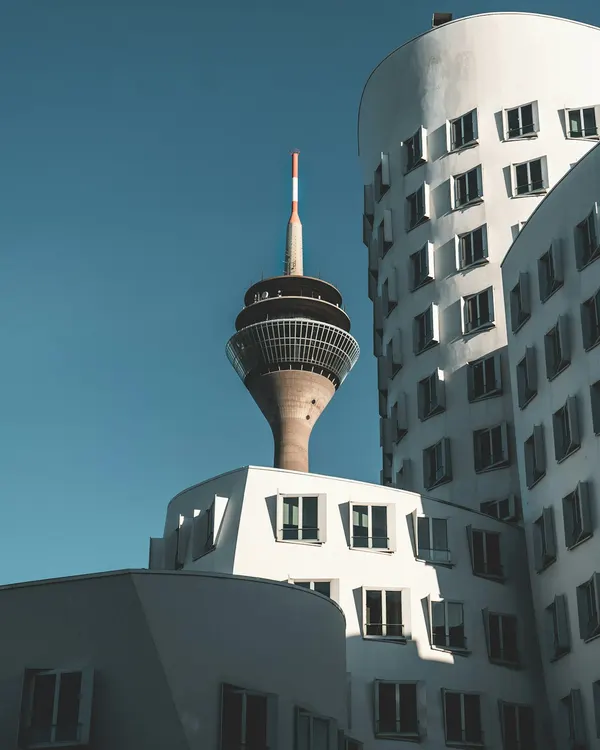
Getting around Düsseldorf-Bilk station has S-Bahn trains and is the southern end of the Wehrhahn U-Bahn line, and the university campus is a short tram, bus or bike ride south.

Search homes in Dusseldorf

Pempelfort

Central living around Nordstraße, close to the Hofgarten

  • professionals
  • couples
  • expats

Pempelfort is one of Düsseldorf's most practical addresses. It lies directly north of the city centre, so the Königsallee, the shopping streets around Schadowstraße and the Altstadt are walkable, yet the district itself is mainly residential, with tree-lined streets of Altbau and post-war apartment buildings. The Hofgarten, Düsseldorf's oldest public park, borders it to the south-west and links it with the Rhine and the art museums, making a green walk into town part of daily life.

Getting around The Wehrhahn U-Bahn line stops at Pempelforter Straße, other U-Bahn and tram lines serve Nordstraße, and the city centre and Hofgarten are a short walk.

Living in Pempelfort · 18 furnished homes

Oberkassel

Elegant left-bank streets facing the Altstadt skyline

  • expats
  • families
  • professionals
  • couples

Oberkassel sits on the left bank of the Rhine, directly opposite the Altstadt, and has long been one of the most sought-after addresses in the city. Its streets are lined with grand apartment houses from around 1900, many with ornate Jugendstil façades, high ceilings and balconies, and the district escaped the heaviest wartime damage. The Luegallee, the main shopping avenue, runs from the river to the Barbarossaplatz with boutiques, delis, cafés and restaurants that serve a well-off, settled population.

Getting around Several U-Bahn lines cross the Rhine on the Oberkasseler Brücke from Luegplatz to the Altstadt and the city centre in a few minutes.

Living in Oberkassel · 15 furnished homes

Derendorf

University of Applied Sciences campus and new housing

  • students
  • young professionals
  • commuters

Derendorf is one of the parts of Düsseldorf that has changed most in recent years. The district lies north of the city centre and Pempelfort, and its older streets of apartment buildings are now joined by new residential quarters built on former railway and industrial land. The largest change has been the arrival of the main campus of Düsseldorf University of Applied Sciences on Münsterstraße, on the site of the former slaughterhouse, which has brought thousands of students into the district.

Daily life is practical. Supermarkets, bakeries and everyday services cluster along Münsterstraße and the surrounding streets, and newer developments include shops, cafés and playgrounds at ground level. The district lacks the café culture of Flingern or the elegance of Oberkassel, but it is close to both the city centre and the Rhine, and the Nordpark and the Rhine meadows in Golzheim are within cycling distance. Older blocks sit next to new buildings, so the streetscape can feel unfinished in places.

For students at the University of Applied Sciences, Derendorf is the obvious choice, and furnished rooms and studios appear regularly in both older and new buildings. Professionals also find modern furnished apartments here, often with lifts, balconies and better insulation than in the Altbau districts. Düsseldorf-Derendorf station has S-Bahn trains, and trams and U-Bahn lines connect the district to the Hauptbahnhof, the Altstadt and the Messe. Construction continues in parts of the area, so check what is being built nearby before you book. In return, Derendorf often offers more modern space for the money than the classic Altbau districts.

Getting around Düsseldorf-Derendorf station has S-Bahn trains, and trams and U-Bahn lines link the district with the Hauptbahnhof, the centre and the Messe.

Search homes in Dusseldorf

Choosing an area in Dusseldorf

What are the best areas for students in Dusseldorf?

Bilk (student district between the university and the medienhafen) and Derendorf (university of applied sciences campus and new housing). Every area above has its own section with transport and what the housing is like.

Where do young professionals and expats live in Dusseldorf?

Flingern (galleries, cafés and concept stores east of the centre), Bilk (student district between the university and the medienhafen), Pempelfort (central living around nordstraße, close to the hofgarten) and Oberkassel (elegant left-bank streets facing the altstadt skyline). Every area above has its own section with transport and what the housing is like.

Found your area? Search Dusseldorf

Search 489 homes