Santa Croce is where a great many students end up living in Florence, and it is easy to see why. The Franciscan basilica, burial place of Michelangelo, Galileo and Machiavelli, presides over a wide piazza where the calcio storico, a bruising historic football match, is played each June. Around it a dense web of streets runs east toward the Sant'Ambrogio market, where locals still buy vegetables, cheese and tripe in the morning, and the bars around Piazza Sant'Ambrogio and Via de' Macci keep going well into the night.
Getting around Walkable to the whole centre, with city buses along the Lungarni and the viali toward Campo di Marte.
Living in Santa Croce · 85 furnished homes
Ponte alle Mosse lies just outside the old walls on the west side of the city, beyond Porta al Prato, and it is where you see ordinary Florentine life rather than postcard Florence. Via Ponte alle Mosse, the main street, is lined with bakeries, grocers, pharmacies and neighbourhood bars, and the surrounding grid of nineteenth- and twentieth-century apartment buildings houses families, retirees and a growing number of students and young workers who have been priced out of the centre or simply want more room.
Getting around Tram T1 at Porta al Prato toward Santa Maria Novella, Scandicci and Careggi, plus city buses along Via Ponte alle Mosse.
Living in Ponte alle Mosse · 63 furnished homes
San Frediano, on the south bank of the Arno, was for centuries a working-class district of weavers and craftsmen, and some of that character survives in the workshops of furniture restorers, framers and leatherworkers that still line Borgo San Frediano and the streets around it. Piazza del Carmine, with the Brancacci Chapel and its Masaccio frescoes, and the medieval gate of Porta San Frediano anchor the area, while Piazza Santo Spirito, on the district's eastern edge, serves as the Oltrarno's open-air living room.
Getting around Walkable to the centre across Ponte alla Carraia and Ponte Santa Trinita, with small city buses through the Oltrarno.
Living in San Frediano · 59 furnished homes
Santa Maria Novella is named after the Dominican basilica whose green-and-white marble façade faces the piazza, but for most newcomers the name means the station. Firenze Santa Maria Novella is the city's main rail hub, with high-speed trains to Rome, Milan and Bologna, regional trains across Tuscany, and both tram lines stopping close by. For anyone who travels often, works outside Florence or simply wants an easy arrival with heavy luggage, few addresses are more practical.
Getting around Firenze Santa Maria Novella station for national and regional trains, tram T1 at Alamanni-Stazione and T2 at Unità for the airport.
Living in Santa Maria Novella · 52 furnished homes
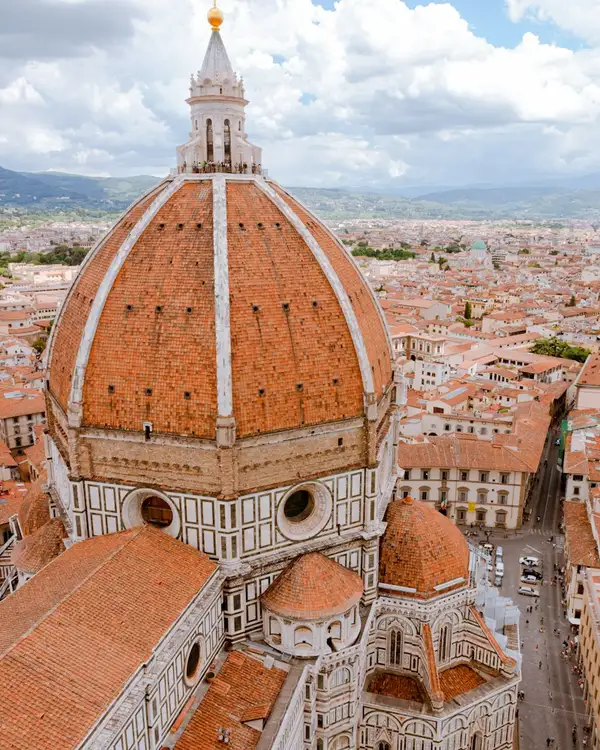
Living around the Duomo means opening your shutters to Brunelleschi's dome, Giotto's bell tower or the terracotta rooftops of the medieval centre. This is the Florence of guidebooks, stretching from the cathedral through Piazza della Repubblica to Piazza della Signoria and the Uffizi, and every major sight is a short walk from your front door. Most streets are pedestrianised or closed to general traffic, and on a winter morning, before the tour groups arrive, the area is surprisingly peaceful.
Getting around Entirely walkable; Santa Maria Novella station and its tram stops are a short walk west, and city buses circle the centre.
Living in Duomo · 52 furnished homes
San Lorenzo is built around food and the Medici. The basilica that gives the area its name was the family's parish church, and the Medici Chapels behind it hold their tombs, while the Mercato Centrale, a nineteenth-century iron-and-glass market hall, sells fish, meat and produce downstairs and runs a busy food hall upstairs. For decades the surrounding streets were lined with leather and souvenir stalls, and Via dell'Ariento and Via Sant'Antonino still have a market-day energy every morning.
Getting around A short walk from Santa Maria Novella station and the T1 and T2 stops, with buses along Via Cavour toward San Marco.
Living in San Lorenzo · 34 furnished homes
Novoli is a different Florence: wide streets, post-war and contemporary apartment blocks and very few tourists. Its transformation began when the old Fiat works were redeveloped, bringing the University of Florence's Polo delle Scienze Sociali, home to law, economics and political science, and the new Palazzo di Giustizia, whose angular, jutting towers are visible from across the city. Between them, the Parco di San Donato offers lawns, playgrounds and paths that fill with students between lectures and with families in the late afternoon.
Getting around Tram T2 between the airport and Unità via Novoli, with buses along Via di Novoli toward the centre.
Living in Novoli
Statuto takes its name from Via dello Statuto, the street running north-west from the Fortezza da Basso, and the surrounding area is a quietly practical part of Florence. Late-nineteenth- and early-twentieth-century apartment buildings line the streets toward Piazza Dalmazia, the main local hub a little to the north, with ground-floor bakeries, greengrocers and bars that cater to residents rather than visitors. It is the kind of neighbourhood where the barista remembers your order by the second week.
Getting around Tram T1 at Statuto and Muratori toward Careggi and Santa Maria Novella, plus regional trains at Firenze Statuto station.
Living in Statuto
Campo di Marte takes its name from the military parade ground that once occupied the area, and today it is Florence's sporting quarter. The Stadio Artemio Franchi, home of ACF Fiorentina, with its slender tower and spiral ramps designed by Pier Luigi Nervi, dominates the district, surrounded by the Mandela Forum arena, swimming pools and training pitches. On match days the streets fill with purple scarves; the rest of the week it is one of the calmer and greener parts of the city.
Getting around Regional trains at Firenze Campo di Marte, with frequent city buses along Viale dei Mille toward the centre.
Living in Campo di Marte
Bellariva stretches along the north bank of the Arno east of the historic centre, between the river and the Campo di Marte district. It is mostly post-war and later residential housing: apartment buildings with balconies, lifts and courtyards, set along wide streets with trees and parking spaces. Few visitors come this way, and the pace is unhurried, with neighbourhood bars, supermarkets and schools serving a population of families and retirees, joined more and more by students and young workers looking for space they cannot find inside the old walls.
Getting around City buses along the Lungarno and the viali to the centre, with Firenze Campo di Marte station a short ride north.
Living in Bellariva