
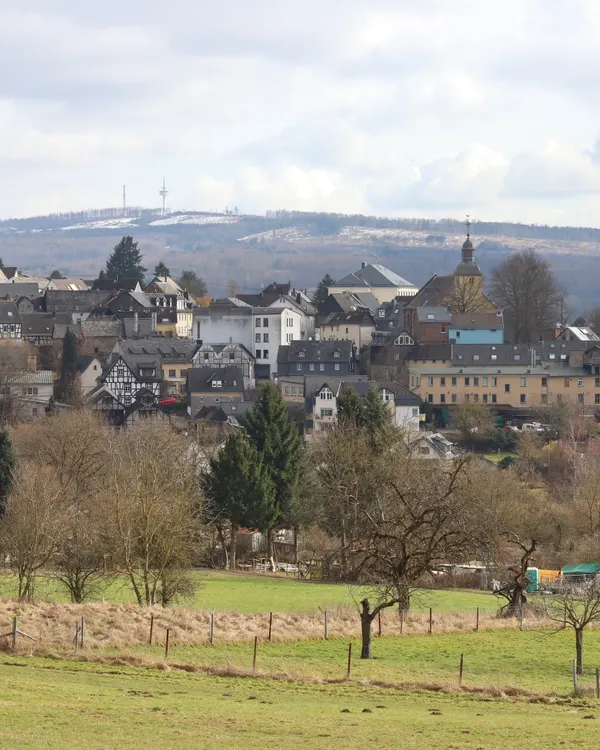
Höhr and Grenzhausen town centre
Two pottery villages grown into one small town
Höhr-Grenzhausen was formed when the neighbouring villages of Höhr and Grenzhausen, together with Grenzau in the valley below, were merged into one town, and the first two have long since grown into each other. What they share is clay. Westerwald stoneware, grey with cobalt-blue decoration, has been thrown and fired here for centuries, and the Keramikmuseum Westerwald tells that story, from medieval jugs to contemporary studio pieces. Pottery workshops and ceramics firms are scattered between the houses, and some open their doors to visitors.
Everyday life is small-town: bakeries, supermarkets, schools, doctors and some cafés, enough to manage most errands without leaving town. Housing is mostly older detached and semi-detached houses, some divided into flats, and small apartment buildings from the post-war decades, with newer family homes on the edges. Furnished rentals are usually a flat in a private house or a small apartment that an owner has equipped for students, researchers or project staff, rather than a purpose-built serviced building. Expect stairs, a garden view more often than a balcony, and a landlord who lives downstairs or nearby.
The centre suits students at the ceramics institute, trainees in local industry and people working in Koblenz who want quieter evenings. Most errands can be done on foot, though a bike helps on the hills. Check how far the nearest bus stop is if you will commute without a car, and ask for the Wohnungsgeberbestätigung for your Anmeldung before you pay anything. If nothing is free, compare the wider area in the area guide or the much larger market in Koblenz.
Getting around Buses run from the centre towards Koblenz and neighbouring Westerwald towns, and the A48 junction Höhr-Grenzhausen is on the edge of town.