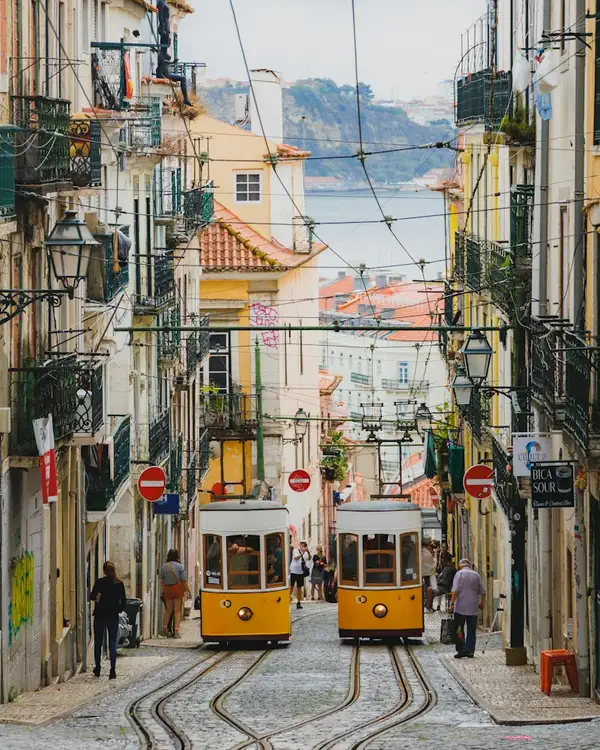
Arroios runs along Avenida Almirante Reis, the long, straight avenue that carries traffic from Martim Moniz up towards Areeiro. Step one block off it and the pace drops: side streets of tiled four- and five-storey buildings, corner cafés with pastéis de nata on the counter, and Mercado de Arroios, where locals still buy fish and vegetables in the morning. It is one of the most international parts of the city, with South Asian, Chinese, Brazilian and African grocers sharing the same blocks. Rents have risen as the area has become fashionable, but it remains more affordable than the riverside quarters.
Getting around Green-line metro at Arroios and Anjos, with Alameda (green and red lines) at the northern end and frequent Carris buses along Almirante Reis.
Living in Arroios · 448 furnished homes
The neighbourhood takes its name from Alameda Dom Afonso Henriques, a long, sloping park that ends at the monumental Fonte Luminosa. On warm evenings the grass fills with students from Instituto Superior Técnico, whose main campus faces the park's southern end. It is one of the few genuinely open spaces in central Lisbon, and it gives the area a more relaxed, residential feel than the streets just south of it. In summer the lawn becomes an informal picnic spot, and joggers circle the park from early morning.
Getting around Alameda station on the green and red metro lines, with Areeiro (green line) just north and direct red-line trains to the airport.
Living in Alameda · 287 furnished homes
Praça Duque de Saldanha is the hinge of the Avenidas Novas, the planned district of wide boulevards laid out north of the old city around the turn of the twentieth century. Avenida da República runs north from here towards Campo Pequeno, lined with offices, banks and apartment buildings, and Pastelaria Versailles, one of Lisbon's grand old tea rooms, is a short walk up the avenue. The district was designed for Lisbon's growing middle class, and many original buildings, with decorative ironwork and tiled entrance halls, still stand between glass office blocks.
Getting around Saldanha interchange on the yellow and red metro lines, with Picoas (yellow) and São Sebastião (blue and red) both within walking distance.
Living in Saldanha · 248 furnished homes
The statue of the Marquês de Pombal, the minister who rebuilt Lisbon after the 1755 earthquake, stands at the centre of the city's busiest roundabout. From here Avenida da Liberdade slopes down to Restauradores and Baixa beneath its plane trees and designer shopfronts, while Parque Eduardo VII climbs the hill behind, rewarding the walk with views across the whole city to the river. The roundabout itself is loud and awkward to cross on foot, so the nicest addresses are a few blocks away from it.
Getting around Marquês de Pombal station on the yellow and blue metro lines, with Parque (blue) and Rato (yellow) one stop away and buses down Avenida da Liberdade.
Living in Marquês de Pombal · 210 furnished homes
Entrecampos sits where Avenida da República meets Avenida das Forças Armadas, at the northern end of the Avenidas Novas. Its biggest draw is position: ISCTE is a short walk away, Cidade Universitária, with the University of Lisbon's rectorate and its faculties of law, letters and medicine, is one metro stop further on, and the Moorish-style Campo Pequeno bullring, now a concert venue with shops underneath, stands just to the south. The National Library and the green expanse of Campo Grande lie a little further north.
Getting around Entre Campos on the yellow metro line, plus Entrecampos railway station for cintura-line trains and Fertagus services to the south bank.
Living in Entrecampos · 250 furnished homes
Benfica feels like a town of its own inside Lisbon. Estrada de Benfica, the old road west out of the city, is lined with bakeries, pharmacies and family-run shops, and Mercado de Benfica draws shoppers from across the parish on weekend mornings. Most residents are Lisbon families rather than newcomers, which keeps the atmosphere settled and the streets quiet at night. Small squares with benches, old-fashioned cafés serving a bica at the counter and a long-established neighbourhood life make it easy to settle into a routine.
Getting around Blue metro line at Colégio Militar/Luz, Alto dos Moinhos and Laranjeiras, plus Benfica station on the Sintra suburban line.
Living in Benfica · 166 furnished homes
Bairro Alto was laid out in the sixteenth century as one of Lisbon's first planned extensions, and its tight grid of lanes came through the 1755 earthquake better than the lower town. By day it is quiet: washing hangs from iron balconies, older residents read the paper outside tascas, and small design shops open late in the morning. By night, especially from Thursday to Saturday, the same streets fill with people drinking outside dozens of tiny bars. Many of them are little more than a counter and a door, so the crowd spills onto the cobbles until the early hours.
Getting around Baixa-Chiado station on the blue and green metro lines, tram 28 through Largo de Camões, and the Glória and Bica funiculars.
Living in Bairro Alto
Santa Apolónia takes its name from the railway terminus that has stood on the riverfront since the nineteenth century and still sends trains north to Coimbra and Porto. Behind the station the ground rises steeply into Alfama and São Vicente, the oldest parts of Lisbon, where streets are often staircases, fado drifts out of small restaurants and the white dome of the National Pantheon dominates the skyline. The Lisbon Cruise Terminal lies along the river nearby, and on some days the ships tower over the waterfront.
Getting around Blue-line metro terminus and Santa Apolónia railway station, with tram 28 climbing through Alfama and buses along the riverfront.
Living in Santa Apolónia