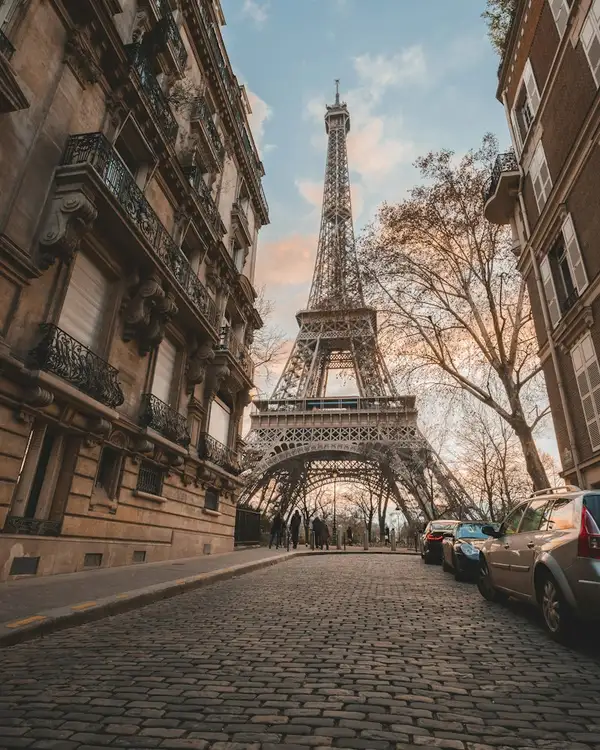
Parisians sometimes call the 15th boring, and they usually mean it as a compliment. This is where people move when they want space, a bakery that remembers their order and an easy ride to work. The arrondissement stretches from Montparnasse to the Seine and still divides into the old villages of Vaugirard, Grenelle, Javel and Necker, which shape its high streets. Rue du Commerce and rue de la Convention are lined with everyday shops rather than boutiques, and the open-air market beneath the elevated line 6 on boulevard de Grenelle is one of the best on the Left Bank.
Getting around Metro lines 6, 8, 10 and 12 cross the arrondissement, with Montparnasse-Bienvenüe on its eastern edge, RER C at Javel and Champ de Mars, and trams T2 and T3a at Porte de Versailles.
Living in 15th arrondissement · 31 furnished homes
The 19th has two faces, and they meet at the water. Around the Bassin de la Villette, summer evenings mean pétanque on the quays, picnics on the stone edges and film-goers crossing between the two MK2 cinemas on opposite banks. Up the hill, Parc des Buttes-Chaumont is where the neighbourhood goes to breathe: artificial cliffs, a little temple perched on a rocky island, steep lawns and the Rosa Bonheur guinguette, which fills on warm nights with a crowd that stays until closing. Sunday mornings bring joggers up the switchback paths and families to the waterfall in the grotto.
Getting around Metro lines 2, 5, 7, 7bis and 11 serve the arrondissement, with Jaurès, Laumière and Buttes Chaumont as key stops, and tram T3b runs along the outer boulevards.
Living in 19th arrondissement · 31 furnished homes
Ask three Parisians about the 17th and you will hear about three different places. The west, around Ternes, Plaine Monceau and avenue de Wagram, is classic bourgeois Paris: cream-stone Haussmann façades, wrought-iron balconies and quiet courtyards within walking distance of the Arc de Triomphe. The east is Batignolles, a former village that kept its church square, its covered market and its small streets of cafés. On rue des Dames or rue des Moines on a Saturday morning, it feels more like a provincial town than a capital, and the covered Marché des Batignolles on rue Lemercier supplies the cheese and wine for Sunday lunch.
Getting around Line 14 at Pont Cardinet and Porte de Clichy, lines 2, 3 and 13 across the arrondissement, RER C at Pereire-Levallois and tram T3b on the outer boulevards.
Living in 17th arrondissement · 28 furnished homes
Montmartre is the postcard: the white domes of Sacré-Cœur, the painters of Place du Tertre, rue Lepic winding up past the Moulin de la Galette. Live here and you learn the other version, with residents' streets on the northern slope around Lamarck-Caulaincourt, morning queues at the bakeries of rue des Abbesses, and staircases you climb with your shopping. Tour groups cluster on the summit; a few streets away the hill is surprisingly quiet, with vines, small squares and views that open suddenly between buildings.
Getting around Line 12 at Abbesses and Lamarck-Caulaincourt, line 2 at Pigalle, Anvers and Barbès, line 4 at Château Rouge and line 13 at Guy Môquet, plus the Montmartre funicular.
Living in Montmartre & the 18th · 15 furnished homes
The 16th has a reputation for old money, and the avenues around Trocadéro and Victor Hugo do little to dispel it. Behind the façade, though, it is simply the calmest part of central Paris: tree-lined streets where the loudest sound is a school bell, the view of the Eiffel Tower from the terrace of the Palais de Chaillot, and the Bois de Boulogne on the doorstep for running, rowing on the lakes and weekend cycling. Rue de Passy and the market streets around it cover daily shopping without fuss, and the Musée Marmottan Monet near La Muette holds the largest collection of Monet's paintings anywhere.
Getting around Lines 6 and 9 at Trocadéro, line 6 at Passy, line 10 on the Auteuil branch, line 2 at Victor Hugo, and RER C stations along the river.
Living in 16th arrondissement · 16 furnished homes
For centuries the Latin Quarter has been organised around learning, and you still feel it on every corner. The Sorbonne, the Collège de France, the École normale supérieure on rue d'Ulm and the Jussieu campus of Sorbonne Université all sit in the 5th arrondissement, alongside Lycée Henri-IV and Louis-le-Grand, where some of France's best students prepare for the grandes écoles. The cafés around place de la Sorbonne are full of people with notebooks, and the small cinemas of rue Champollion still screen the classics. Above it all, the Panthéon, where Marie Curie and Victor Hugo are buried, crowns the hill of Sainte-Geneviève.
Living here means old buildings, narrow staircases and small rooms, often with exposed beams and a view across zinc rooftops. Studios and chambres de bonne dominate, and demand peaks every year before the rentrée in September, so start early if you want to walk to class. Rue Mouffetard and place Monge have markets, the Jardin des Plantes and its natural history galleries make a fine study break, and the Jardin du Luxembourg lies just over the border in the 6th.
The trade-off is tourism. The streets around Saint-Michel and rue de la Huchette are crowded and noisy in season, and the riverside near Shakespeare and Company rarely empties. Head south towards Censier or east towards Jussieu for calmer evenings. If availability is tight, the 13th and 14th are a quick hop on line 7 or RER B, and the 15th is a direct ride on line 10. Compare studios for rent in Paris across the Left Bank.
Getting around RER B and C at Saint-Michel, RER B at Luxembourg, line 10 at Cluny-La Sorbonne and Maubert-Mutualité, and line 7 at Place Monge and Jussieu.
Search homes in Paris
The Marais escaped Haussmann's demolitions, which is why it still looks like the Paris of several centuries ago: narrow streets, two half-timbered houses on rue François-Miron, and grand hôtels particuliers built around cobbled courtyards. Many now house museums, among them the Musée Picasso, the Musée Carnavalet and the Archives nationales, and the brick-and-stone arcades of Place des Vosges frame one of the most beautiful squares in Europe, busy with picnics on any sunny afternoon.
Daily life is lively and very central. The upper Marais around rue de Bretagne has the Marché des Enfants Rouges, the oldest covered market in Paris, plus concept stores and small restaurants. The lower Marais is busier: rue des Rosiers and its falafel counters in the historic Jewish quarter known as the Pletzl, and the bars of rue Vieille-du-Temple and rue des Archives that anchor the city's LGBTQ+ scene. Many shops here open on Sundays, which is still unusual in Paris, and on Sunday afternoons rue des Francs-Bourgeois fills with strollers, street musicians and shoppers.
Apartments are mostly in old stone buildings, often charming, rarely large, and lifts are the exception rather than the rule. Expect strong competition for anything furnished, especially studios and one-bedroom flats wanted by professionals and couples. Noise from bars carries late at weekends, so ask whether a flat faces the street or the courtyard; ground-floor flats on narrow lanes can also be dark, so study the photos for natural light. The Latin Quarter is a short walk across the Île Saint-Louis, and you can compare a wider choice of furnished apartments in Paris in other districts.
Getting around Line 1 at Saint-Paul and Hôtel de Ville, lines 3 and 11 at Arts et Métiers, line 8 at Chemin Vert and Saint-Sébastien-Froissart, and the RER hub of Châtelet-Les Halles next door.
Search homes in Paris
On a warm evening, half of north-east Paris seems to sit with its legs dangling over the Canal Saint-Martin. The canal runs south from the Bassin de la Villette through a chain of locks and under green iron footbridges before disappearing beneath boulevard Richard-Lenoir, and its quays, quai de Valmy and quai de Jemmapes, are shaded by plane trees and lined with cafés and bike racks. The Hôtel du Nord, made famous by Marcel Carné's 1938 film, still stands by the water. On Sundays the quays close to cars, and the canal becomes a long promenade for cyclists, skaters and families.
The streets behind the quays carry the area's real character. Rue de Lancry and rue Beaurepaire have independent shops, wine bars and bakeries; rue du Faubourg-Saint-Denis, further west, is a rush of Kurdish, Indian and Turkish restaurants, covered passages and late-night food. Point Éphémère, a converted warehouse on the canal, hosts concerts and exhibitions. Buildings are mostly 19th-century and residential, with plenty of shared flats behind their tall shutters.
Connections are a major draw. Gare du Nord sends Eurostars to London and Brussels and RER B trains to Charles de Gaulle airport, Gare de l'Est serves eastern France and Germany, and République is a five-line metro hub, which makes the area ideal if you travel often. The downsides are crowds on the quays at night and rough edges around the stations. Search rooms for rent in Paris to see shared flats around the canal and in the neighbouring 19th arrondissement.
Getting around Lines 3, 5, 8, 9 and 11 at République, line 5 at Jacques Bonsergent, line 11 at Goncourt, and RER B, D and E at Gare du Nord and Magenta.
Search homes in Paris