
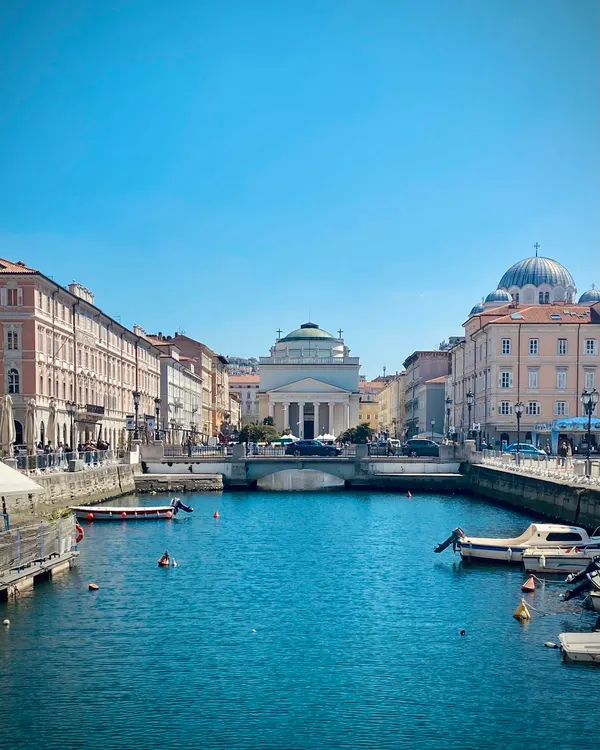
Borgo Teresiano
The Habsburg grid around the Canal Grande
In the eighteenth century, as Trieste grew into the Habsburg Empire's port, salt pans north of the old town were filled in and laid out as a new quarter on a regular grid. Named after Empress Maria Theresa, the Borgo Teresiano is still the most orderly part of the city: straight streets of neoclassical palazzi, many with tall windows and ornate staircases, running between the station and the seafront. At its centre is the Canal Grande, lined with boats and café tables and closed at its inland end by the church of Sant'Antonio Taumaturgo.
The quarter reflects Trieste's mixed history. The Serbian Orthodox church of San Spiridione stands beside the canal, a bronze James Joyce, who lived in the city for years, strolls across the Ponterosso bridge, and historic coffee houses keep the city's coffee culture alive. Piazza Unità d'Italia, opening onto the sea, is a few minutes' walk south, and the Rive, the seafront promenade, is where everyone walks on a sunny afternoon.
For renters, the Borgo Teresiano offers something rare in Trieste: flat streets in the middle of town. Flats are in older buildings with high ceilings and generous rooms, though lifts are not guaranteed and heating varies, so ask about both. The station is on the northern edge, buses to the university leave from nearby, and shops, markets and restaurants are all on foot. Some streets near the station are busier and noisier than the quieter blocks towards the canal, so check the exact location in our neighbourhood guide.
Getting around Flat and walkable; Trieste Centrale station is on the northern edge, and buses from the nearby stops run up to the university and along the coast.