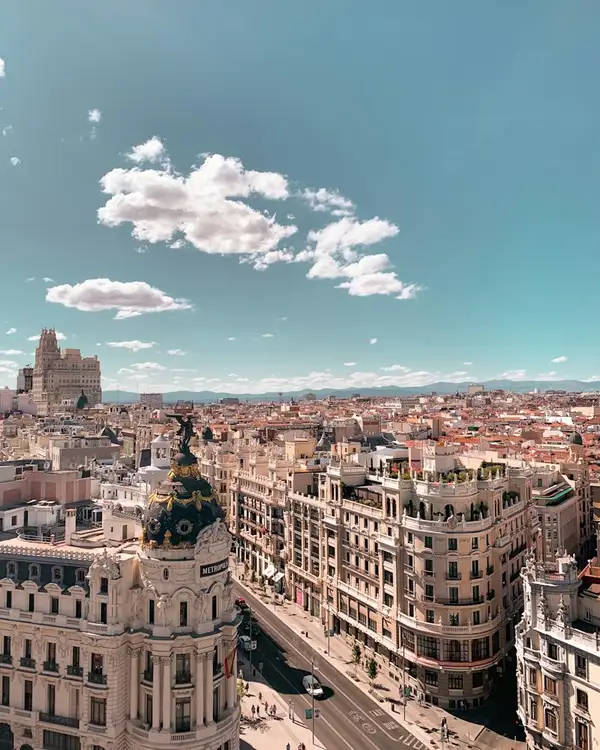
Lavapiés tumbles downhill from Tirso de Molina towards the Ronda de Atocha, and few places in Madrid pack so much into so few streets. Officially it belongs to Embajadores, the old working-class quarter south of the Plaza Mayor, and it has long been where newcomers to the city land first. That history shows in the curry houses on Calle Lavapiés, the grocers selling plantains and spices, the art-house cinema queues and the Sunday flea market of El Rastro spilling down Ribera de Curtidores.
Getting around Metro Lavapiés (line 3), Embajadores (3, 5) and Tirso de Molina and Antón Martín (line 1); Cercanías trains stop at Embajadores.
Living in Lavapiés · 95 furnished homes
In the 1980s Malasaña was the stage for La Movida, the burst of music, art and nightlife that followed the end of the dictatorship, and the barrio still runs on some of that energy. Its official name is Universidad, after the old Universidad Central building on Calle San Bernardo, and it stretches from Gran Vía north to the boulevards, between Calle Fuencarral and Calle Princesa. At its centre is Plaza del Dos de Mayo, full of children on bikes by day and crowded terraces by night.
Getting around Tribunal (lines 1, 10), Bilbao (1, 4), Noviciado (2), San Bernardo (2, 4) and Plaza de España (3, 10) surround the barrio.
Living in Malasaña · 104 furnished homes
Puerta del Sol is where Spain measures its distances. A plaque in front of the Real Casa de Correos marks Kilometre Zero of the national road network, and every New Year's Eve the clock above it leads the whole country through the ritual of the twelve grapes. The barrio of Sol stretches from Gran Vía down past Calle Preciados, Calle del Carmen and Calle Arenal towards the Plaza Mayor, and it is about as central as you can live in Madrid.
Getting around Sol (lines 1, 2, 3 and Cercanías), with Gran Vía (1, 5), Callao (3, 5) and Ópera (2, 5, R) a few minutes' walk away.
Living in Sol · 78 furnished homes
The barrio of Palacio covers the oldest part of Madrid, the ridge where the Muslim fortress of Mayrit once stood and where the Royal Palace now rises above the Campo del Moro gardens. Around it, Plaza de Oriente, the Teatro Real opera house and the Almudena Cathedral give the area a stately air, while the streets to the south, around Calle Mayor, the Mercado de San Miguel and La Latina, are a tangle of taverns, churches and old townhouses.
Getting around Ópera (lines 2, 5 and Ramal) and La Latina (5), with Sol a short walk away and Príncipe Pío (6, 10, R and Cercanías) just down the hill.
Living in Palacio & La Latina · 79 furnished homes
First, the honest part: Getafe is not a neighbourhood of Madrid but a separate city in the south of the region, with its own town hall, its own football club and its own fiestas. Plenty of people rent here anyway, and for good reasons. The Universidad Carlos III de Madrid runs its Getafe campus here, home to its social sciences, law and humanities faculties, and the town is a major employment centre, with Airbus among the industrial employers on its edges.
Getting around Cercanías C-4 from Getafe Centro and Las Margaritas-Universidad to Atocha and Sol; Metrosur line 12, linking with line 10 and with line 3 at El Casar.
Living in Getafe · 96 furnished homes
Castillejos is a study in contrasts. Its eastern edge is the Paseo de la Castellana, Madrid's great north–south boulevard, lined here with ministries, banks and glass office blocks; its western edge is Calle Bravo Murillo, a long, busy shopping street of fruit shops, bakeries and restaurants from Latin America, Asia and Africa. In between lie the side streets of the Tetuán district, where older low-rise houses stand beside 1960s blocks and newer apartment buildings.
Getting around Line 10 along the Castellana (Santiago Bernabéu, Cuzco) and line 1 along Bravo Murillo (Tetuán, Valdeacederas), with Plaza de Castilla to the north.
Living in Castillejos (Tetuán) · 69 furnished homes
Just north of the Glorieta de Bilbao, where Malasaña's bars give way to wider pavements and older residents, Trafalgar is Chamberí at its most typical. The area was laid out in the late nineteenth and early twentieth centuries as Madrid spread beyond its old walls, and streets such as Fuencarral, Luchana, Trafalgar and Eloy Gonzalo are lined with handsome apartment buildings, ornate balconies and grand entrance halls. At its centre, Plaza de Olavide is a ring of terraces around a children's playground.
Getting around Bilbao (lines 1, 4), Iglesia (1) and Quevedo (2), with Alonso Martínez (4, 5, 10) a short walk south.
Living in Trafalgar (Chamberí)
Arapiles is the kind of Madrid barrio that rarely appears in guidebooks and is all the better for it. Spreading west from the Glorieta de Quevedo along streets such as Arapiles, Magallanes and Galileo, it is a grid of solid apartment buildings from the twentieth century, with bakeries, fruit shops, family-run restaurants and bars where the menú del día is chalked up on a board at lunchtime. Most of the people you meet in the lift will have lived here for years.
Getting around Quevedo (line 2), San Bernardo (2, 4), Canal (2, 7) and Islas Filipinas (7).
Living in Arapiles (Chamberí)
Gaztambide sits where Chamberí meets Moncloa, and it shows. Streets such as Gaztambide, Hilarión Eslava, Fernández de los Ríos and Fernando el Católico combine solid residential buildings with a high density of student bars, copy shops and cheap places to eat, because Ciudad Universitaria, home to most faculties of the Complutense and many of the Politécnica's schools, lies just beyond the Moncloa interchange. On a weekday lunchtime, half the people in the bars seem to be carrying lecture notes.
Getting around Moncloa (lines 3, 6 and intercity buses), Argüelles (3, 4, 6) and Islas Filipinas (7), with buses into Ciudad Universitaria.
Living in Gaztambide (Chamberí)
Chueca is known well beyond Spain as the centre of Madrid's LGBTQ+ community, and each summer it becomes the focal point of Madrid Pride, one of the largest celebrations of its kind in Europe. The official barrio, Justicia, also takes in the quieter, more elegant streets around Plaza de las Salesas and Alonso Martínez, where the Supreme Court and a string of independent boutiques, bookshops and wine bars give the area a polished air.
Getting around Chueca (line 5), Alonso Martínez (4, 5, 10), Colón (4) and Gran Vía (1, 5), with Banco de España (2) at the southern edge.
Living in Chueca
Cervantes, Lope de Vega and Quevedo all lived in these streets in the seventeenth century, and the Barrio de las Letras has never let anyone forget it: quotations from Spanish literature are set in bronze letters into the pavement of Calle de las Huertas, and Lope de Vega's house survives as a museum. The barrio of Cortes takes its name from the Congress of Deputies on Carrera de San Jerónimo and runs down from Plaza de Santa Ana towards the Paseo del Prado.
Getting around Antón Martín (line 1), Sevilla and Banco de España (2), with Sol (1, 2, 3 and Cercanías) and Atocha (1 and Cercanías) within walking distance.
Living in Huertas & Barrio de las Letras
The Salamanca district was built in the nineteenth century as an orderly grid for Madrid's growing middle classes, and Goya is its busiest commercial corner. Calle Goya and Calle Alcalá are lined with department stores, fashion chains and cafés, while the side streets hold handsome apartment buildings with doormen, balconies and high ceilings. The WiZink Center, the city's main indoor arena for concerts and basketball, sits on the edge of the barrio, and the Retiro park is a short walk away.
Goya appeals to young professionals, couples and families who want a well-ordered neighbourhood that feels safe and central. Furnished apartments here are often spacious, and many have lifts, central heating and air conditioning, which makes a real difference in a Madrid summer. Rooms in shared flats are common too, usually in large apartments let to professionals and postgraduates, including business school students. The atmosphere is more formal than in the old centre, with fewer late-night bars and more traditional restaurants and cafeterías.
Daily life is comfortable. Markets, bakeries and supermarkets are plentiful, the Retiro offers running routes, rowing boats on the lake and lazy Sunday afternoons, and Goya station links metro lines 2 and 4. Nights are quiet compared with Malasaña or Huertas, and most noise comes from traffic on the big avenues, so a flat on a side street makes a difference. Concerts at the WiZink Center bring crowds on event nights. For a livelier central alternative within walking distance, compare Chueca, just across the Paseo de Recoletos.
Getting around Goya (lines 2, 4), Príncipe de Vergara (2, 9) and Manuel Becerra (2, 6), plus frequent buses along Calle Alcalá.
Search homes in Madrid
Cross the Puente de Segovia from the old centre and you are in Puerta del Ángel, a barrio of the Latina district wedged between the River Manzanares and the vast Casa de Campo park. For decades it was a modest working-class neighbourhood; since the riverbanks were transformed into the Madrid Río park, it has become one of the most talked-about residential areas in the city, with new cafés, bakeries and bars opening alongside traditional shops on Paseo de Extremadura and Calle Caramuel.
Getting around Puerta del Ángel and Alto de Extremadura (line 6), with Príncipe Pío (6, 10, R and Cercanías) a short walk away.
Living in Puerta del Ángel
Usera has become known as Madrid's Chinatown, home to the city's largest Chinese community and to restaurants that draw food lovers from across the capital, especially around Calle Marcelo Usera. Almendrales is the barrio on the district's northern side, running down towards the Manzanares and Madrid Río, with Legazpi and the Matadero cultural centre just across the river. It is one of those parts of Madrid that visitors rarely see and residents increasingly recommend.
Most housing here dates from the decades after the Spanish Civil War: brick apartment blocks, some with lifts, many with small balconies, plus newer buildings closer to the river. Flats tend to be practical rather than charming, and they suit students, young workers and anyone who would rather have a bigger room than a famous postcode. Rooms in shared flats are the most common furnished lets, and whole apartments come up for couples and small families. Check whether the building has a lift and how the flat is heated before booking.
Daily life is unpretentious and multicultural. Bakeries, Latin American restaurants, Chinese supermarkets and old Madrid bars sit side by side, and Chinese New Year brings parades and dragon dances to the streets. Madrid Río is a short walk away, and the Matadero, a former slaughterhouse turned into exhibition spaces, a cinema and theatres, is just over the footbridge. Line 3 runs from Almendrales straight to Sol without a change, which makes the commute into the centre simple. Next door across the river, Delicias offers a similar balance of calm and connections.
Getting around Almendrales (line 3), with Legazpi (3, 6) across the river and Usera (6) nearby.
Search homes in Madrid
Step south across the Rondas from Lavapiés and the streets straighten out, the buildings grow taller and the pace slows a little. This is Palos de Moguer, a barrio of the Arganzuela district bounded by Atocha station, Embajadores and the Paseo de las Delicias. It is still very central: the Reina Sofía museum stands near its northern edge, and Atocha, Madrid's biggest railway station, with a tropical garden in its old iron-and-glass hall, is a short walk away.
Housing is mostly apartment buildings from the early and mid-twentieth century, with wider streets and more exterior flats than in Lavapiés. Lifts are more common, and floor plans tend to be roomier. Rooms in shared flats attract students and young workers who want to be close to the centre without its noise, while furnished apartments suit couples and people relocating for work. Streets such as Batalla del Salado and the area around Paseo de Santa María de la Cabeza have neighbourhood bars, cafés and small shops.
Daily life is convenient. Supermarkets and markets are close, Atocha offers Cercanías, metro and high-speed trains to the rest of Spain, and line 3 runs from Palos de la Frontera station to Sol in a few stops. Madrid Río and the Matadero can be reached on foot to the south, and the Retiro lies just beyond Atocha. Evenings are calm compared with the old centre, which many residents see as the whole point of living here. If you want more nightlife, Lavapiés is just across the street.
Getting around Palos de la Frontera (line 3), Embajadores (3, 5 and Cercanías) and Atocha (line 1, Cercanías and long-distance trains).
Search homes in Madrid
Every year on 15 May, Madrid celebrates its patron saint, and the heart of the party is here, on the slopes of the Parque de San Isidro, where families picnic, many dress in traditional chulapo costume and people queue to drink from the spring at the saint's hermitage. For the rest of the year, San Isidro is a residential barrio in the north of the Carabanchel district, just across the Manzanares from the centre, with views back towards the Royal Palace and the city skyline.
The barrio has a strong Latin American presence, reflected in its bakeries, restaurants and shops, alongside long-established Madrid families and a growing number of young people looking for space. Housing is mainly brick apartment blocks from the mid-twentieth century, with some newer buildings and a few older houses. Flats are generally larger than in the centre, and rooms in shared flats suit students and young workers who don't mind a short metro ride. Furnished whole apartments are a good option for couples.
Carabanchel has also become a magnet for artists, with studios and galleries opening in former warehouses and workshops across the wider district. Daily life is local and relaxed: markets, small supermarkets and bars line the main streets, and the park offers some of the best sunset views in Madrid. Line 5 from Marqués de Vadillo and Urgel reaches La Latina and Ópera quickly, and Oporto connects with line 6. Neighbouring Puerta del Ángel, to the north, adds Madrid Río and Casa de Campo to the mix.
Getting around Marqués de Vadillo and Urgel (line 5) and Oporto (5, 6), with buses across the river to the centre.
Search homes in Madrid
Delicias owes its name and much of its character to the railway. The old Delicias station, a nineteenth-century iron-and-glass terminus, now houses the Museo del Ferrocarril, Madrid's railway museum, with historic locomotives lined up beneath its roof. Paseo de las Delicias, a long avenue lined with trees, runs south from Atocha through the barrio towards Legazpi, and the streets either side of it form one of the quieter residential corners of central Madrid.
Apartment blocks from the mid-twentieth century line most streets, many with lifts and balconies, and flats tend to be roomier than in the old centre. Rooms in shared flats suit students and young workers, while whole furnished apartments attract couples and professionals who commute through Atocha. Local life centres on the markets, cafés and bars along Paseo de las Delicias and its side streets, where you are more likely to hear neighbours chatting than tourists asking for directions. Summer evenings bring people out onto the benches along the avenue.
Getting around is simple: Delicias station on line 3 reaches Sol in a few stops, Atocha is a walk away, and Méndez Álvaro, with the main southern bus station, is close by. Madrid Río and the Matadero cultural centre are within walking distance, as is the Planetarium in Tierno Galván park. Evenings are calm, which makes Delicias a good fit for anyone who wants a central base without the noise of the old centre. Compare it with neighbouring Palos de Moguer, a few streets closer to Atocha, before you decide which side of the Paseo suits you.
Getting around Delicias (line 3), with Méndez Álvaro (line 6 and Cercanías) and Atocha within walking distance.
Search homes in Madrid