Partner guide · Berlin moving · ~11 min read · August 2026
What a Move in Berlin Actually Costs in 2026 — and the Permit Nobody Tells You About
Guest contribution by Mahmoud Abdel-Halim, BerlinUmzugPro
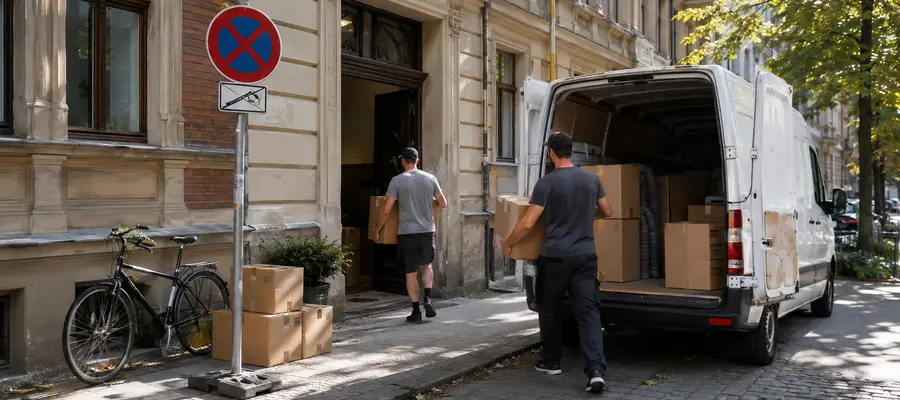
In short: Most newcomers budget for rent and deposit, then get surprised by the move itself. For a local Berlin move with a company truck and crew, expect roughly €350–1,300 depending on flat size — but stairs, courtyards and parking distance often push hourly quotes higher. Budget €70–100 for a Halteverbotszone parking permit and apply at least two weeks ahead.
Most people moving in Berlin budget for the rent, the deposit and maybe a few boxes. The move itself is an afterthought — until the quote arrives, and it is two or three times what they had in mind.
Here is what a move in Berlin actually costs in 2026, what makes the number go up, and the one bureaucratic detail that catches almost every newcomer.
The numbers
For a local move within Berlin, carried out by a company with a truck and two to three movers, loading and unloading included:
| Apartment | Typical total |
|---|---|
| 1 room, ~30 m² | €350–600 |
| 2 rooms, ~60 m² | €600–1,000 |
| 3–4 rooms, ~80–100 m² | €800–1,300 |
Two pricing models are normal here.
Hourly: a truck with two movers typically starts at €160–190 for the first two hours, then roughly €80–90 per additional hour. A larger team of three or four starts around €250, with about €120–130 per extra hour.
Fixed price: quoted after someone has actually seen the flat, in person or over video.
If you rent the van yourself and only book the labour, helper-only rates in Berlin run about €20–30 per person per hour. For a furnished or medium-term flat where you mostly own suitcases and a few boxes, this is often all you need — and it is worth asking for it explicitly rather than accepting a full-service quote you don't need.
What actually drives the price up
Almost nobody's quote goes wrong because of the furniture. It goes wrong because of the building.
- The stairs. A fourth-floor Altbau with no lift can add an hour or more of labour at each end of the move. Many Berlin buildings have no lift at five storeys.
- The carrying distance. If the truck cannot park within about ten to fifteen metres of the front door, every single item takes longer. On an hourly rate, you pay for that distance twice — once loading, once unloading.
- The courtyard. Berlin flats are often in a Hinterhaus or Seitenflügel, thirty to sixty metres behind the street entrance. Mention this when you ask for a quote. It is the single most common reason a quote turns out too low.
- Disassembly and reassembly. Wardrobes, bed frames and especially fitted kitchens. Reckon on roughly 25–40% on top of a plain transport price.
- Packing service. Around €20–35 per hour if the company packs for you.
- The date. The end of the month, the last Friday of the month, and the peak season from roughly April to September are both the most expensive and the hardest to book. Mid-month, mid-week is cheaper and far easier to schedule. If your lease dates give you any flexibility at all, this is where the savings are.
The permit nobody tells you about
In Berlin you can reserve the parking spaces directly in front of your building for moving day. It is called a Halteverbotszone, and it is the most underestimated part of a Berlin move.
How it works
You apply to the traffic authority of the district the street belongs to. The authority issues the permit but does not provide the signs. The physical signs have to be rented, put up and taken down — usually by the moving company or a specialist provider.
What it costs
The official fee starts at around €21. Including the signs, delivery, setup and removal, budget roughly €70–100 for a one-sided zone for a single day.
How early you need to apply
This is where people get caught. The signs must be standing for 72 hours before the zone takes effect, and the authority needs processing time on top of that. Plan at least two weeks. Berlin's own official guidance cites average processing times of up to four weeks, and in peak season, in busier districts, it is worse. Applying five days before your move is usually too late.
If a car is parked there anyway
With a correctly posted zone and the 72-hour period observed, the vehicle can be towed at the owner's expense. If immediate action is required, call the police on 110; alternatively, contact the local Ordnungsamt. But that costs you an hour or two on moving day, which is the real reason to get the signs up early rather than rely on enforcement.
Skipping the permit to save €80 is usually a false economy. Without it, the truck ends up forty to sixty metres down the street, and on an hourly rate you pay for that twice.
Moving in and out of a furnished flat
Furnished and medium-term rentals change the maths, and mostly in your favour.
You are moving suitcases, boxes, a bike and maybe a desk — not a wardrobe and a sofa. That usually means a smaller vehicle, a shorter job and often a helper-only booking rather than full service. Say this clearly when you request a quote, and ask for a price based on what you are actually moving. A company quoting you for a three-room household when you have twelve boxes is either not listening or not being straight with you.
Two things that do still catch people out. First, furnished flats are frequently in older buildings with the same narrow stairwells as everywhere else — the volume is small, but the carrying is not necessarily easy. Second, the handover matters: furnished lets are often inspected against an inventory list, so leaving cleaning and any repairs to moving day itself is a bad idea.
If you are still searching for a furnished place, see our guide on how to search for furnished housing in Berlin and how to find a furnished apartment in Berlin.
When the dates don't line up
This is the most common problem we see, and it has nothing to do with furniture.
You have to be out of the old flat on the 31st. The new one is not free until the 15th of the following month. Two weeks with a household and nowhere to put it.
Your options, in order of how well they usually work:
- Ask for an overlap. If you can negotiate even a few days where you hold both keys, take it. Moving with the keys already in hand is a completely different experience from moving against a deadline.
- Split the move. Put the household in storage and yourself somewhere short-term. A medium-term furnished rental for the gap is generally cheaper and far less stressful than a hotel, and it means you are not living out of a suitcase in a half-empty flat.
- Move twice. The expensive option, and worth avoiding — two moves cost roughly double one move, plus storage.
The mistake is leaving this until the last two weeks. Storage and short-term housing both need booking ahead, especially between April and September.
How to read a quote
Warning signs
- A fixed price quoted without anyone seeing the flat, in person or by video. Nobody can price a move from the number of rooms alone.
- No written quote, or a quote without a full company address and tax details. A legitimate German company has a proper Impressum and issues a proper invoice showing VAT where applicable, or stating the applicable VAT exemption.
- Cash only, or a large deposit demanded before moving day.
- A price dramatically below everyone else. The classic Berlin version is that the truck gets loaded and only then does the price go up. Once your belongings are on the vehicle, your negotiating position is gone. This is the most common complaint we hear from people who switch companies mid-process.
- An hourly quote with no estimate of total hours and no upper limit.
Worth asking before you sign
- Is this a fixed price or an hourly rate, and what exactly is included? Get the answer in writing.
- How many movers, and how many hours have you estimated?
- Is the parking permit included, and who applies for it?
- What happens if the move runs longer than estimated?
What German law says about liability
Under §451e of the German Commercial Code (HGB), a moving company's liability for loss or damage is generally capped at €620 per cubic metre of loading space required for the move. Exceptions may apply, and a higher level of protection can be agreed or insured separately.
For high-value items, ask what additional transport insurance is available and what it costs. Photograph anything valuable or fragile before the move, and report damage immediately and in writing rather than after the fact.
The short version
Budget €350–1,300 depending on the size of the flat. Add €70–100 for the parking permit and apply for it at least two weeks ahead. Mention the floor, the lift and the courtyard when you ask for a quote — those three things, not your furniture, decide what you pay. Move mid-month and mid-week if you can. And never let anyone load the truck before the price is in writing.
Sources
- Halteverbot application, responsible authority and processing times: Berlin.de — Halteverbote für Umzug beantragen
- Statutory liability cap: §451e HGB
- Registration deadline and Wohnungsgeberbestätigung: service.berlin.de — Wohnung anmelden
- Price ranges: 2026 Berlin market comparison data, cross-checked against our own operations